生き甲斐 · a reason for being

Balance is
a whole life.

A non-custodial vault on Hedera. Your HBAR, your wallet, your pace — a strategy that can sit still through every season.

Why this exists

Three answers, up front

Before you scroll further, here's what this is really about — in plain terms, so you can decide whether it's worth the read.

一 · Why we built it
For people who don't want to watch charts

Most crypto tools are made for someone who follows the market all day. We built one for the person who has better things to do — but still wants their HBAR to work while they're doing them.

二 · Why it matters
HBAR earns nothing sitting still, and holding through a crash costs most of it

Holding HBAR through 2022 lost 87%. Holding through 2025 lost 60%. Most of the money in crypto isn't made by trading well. It's made by being in when it truly rises, and out when it truly falls.

三 · What it gives you
A vault that follows the tide, over years

Not life-changing income. A rule-based strategy that holds HBAR in a rising market, holds dollars in a falling one, and picks up the difference in between. Ten years is the horizon we build for, not ten months.

The strategy right now

Live from the bot, updated every minute

Not a public vault yet. This is the private test account we've been running since the start of the year.

Tide
…
Position
…
Days in this tide
…
Fees, net
…
pool fees minus gas

loading…

The concept

What is Ikigai?

Ikigai (生き甲斐, "a reason for being") is a Japanese concept, put on paper by the psychiatrist Mieko Kamiya in 1966, later carried around the world through research on Okinawa — an island where people live unusually long lives and keep finding meaning in their work well past retirement age.

The idea in one line: a good life sits at the meeting point of four questions. What you love. What you're good at. What the world needs. What pays.

Most people get two or three. Getting all four is rare, and the fourth — being paid for what you love, are good at, and the world needs — is usually where the compromises happen that undermine the other three. Someone picks work that pays and loses time for what they love. Someone picks work they're good at and loses the sense that it matters.

This vault is our small answer to that fourth question. We didn't name it Ikigai because it's a nice word — we named it because the four circles are literally how we shape the strategy.

一 what you love 二 what you're good at 三 what the world needs 四 what pays 生き甲斐 · ikigai — where they meet
How the four circles apply here

Every strategy is a balance
among these four

Each pillar below is one of Ikigai's four questions, translated to a concrete design decision in the vault. Read them left-to-right, top-to-bottom.

一 · What you love (your horizon)

Ten years, not ten months

Retirement, a second income, or simply putting your HBAR to work: the vault starts from your horizon, not from the market's daily noise. Long enough that compounding matters, short enough that you'll be around to see it.

Design impact: monthly reports, no real-time notifications, no gambling loop.

二 · What you can carry (your risk)

Risk measured honestly

Our backtest over six years shows the vault 60–70% below its peak at the worst point. Holding HBAR fell 93%. That's HBAR being HBAR. We tell you before you deposit, not after.

Design impact: max drawdown shown next to every return figure. Never one without the other.

三 · What the market offers (the tide)

Follow the tide, don't predict it

Flood: all HBAR, ride the rise. Ebb: all dollars, wait it out. Slack water: half of each. The strategy follows the tide. It doesn't try to predict it.

Design impact: the vault only moves after a change has held for three days, about sixteen times a year, not on noise.

四 · What pays (our fee)

One fee, at the end

15% of your gain, taken only when you withdraw it. Nothing else. Fixed in the contract, visible on HashScan.

Design impact: we earn when you leave with more than you came with, so a bad decade is a bad decade for us too.

The core idea

Balance is a whole life —
and a whole cycle.

The same motion on two scales. A person finds balance among what they want, what they can carry, what the market offers, and what pays. A vault finds balance between HBAR and dollars, depending on the tide. The vault watches both.

生き甲斐 · human

Balance in a life

Four forces that overlap. Where they meet, your strategy lives. Shift one — a longer horizon, less risk — and the meeting point shifts with it.

·
潮 · technical

Balance in the vault

Flood, slack water, ebb. The vault holds HBAR when the tide rises, dollars when it falls, and half of each in between. Its balance only shifts once the tide has truly turned.

生き甲斐 · 潮

Where balance is,
a healthy state follows.

How it works

The vault follows the tide

Think of the market as water. The vault draws a waterline: the average HBAR price over the past 75 days. When the price sits well above that line, it's flood. Well below: ebb. Close to it: slack water.

How far is "well"? That depends on how rough the water is. In calm months the margin is small; in wild months it widens, so the vault doesn't react to every ripple. And it only believes a change once it has held for three days in a row, going in and going out. It is never first. It is rarely fooled.

What it does in each tide

Flood. Everything in HBAR, and sit still. No profit-taking on the way up, no stop that throws it out on a dip. It rides the rise until the price has been back near the waterline for three days.

Ebb. Everything in dollars. And three buy orders waiting far below the waterline, at 40, 50 and 60 percent under it. If the market panics that deep, the vault buys there, a small part at a time. Those are the moments when nobody wants to buy, and afterwards it was the best thing to do.

Slack. Half HBAR, half dollars. And otherwise nothing.

On average, the vault changes position about sixteen times a year. Roughly once every three weeks.
waterline · 75-day average flood slack water ebb a ripple three days
The band widens when the market is rough, so a ripple is not a tide.
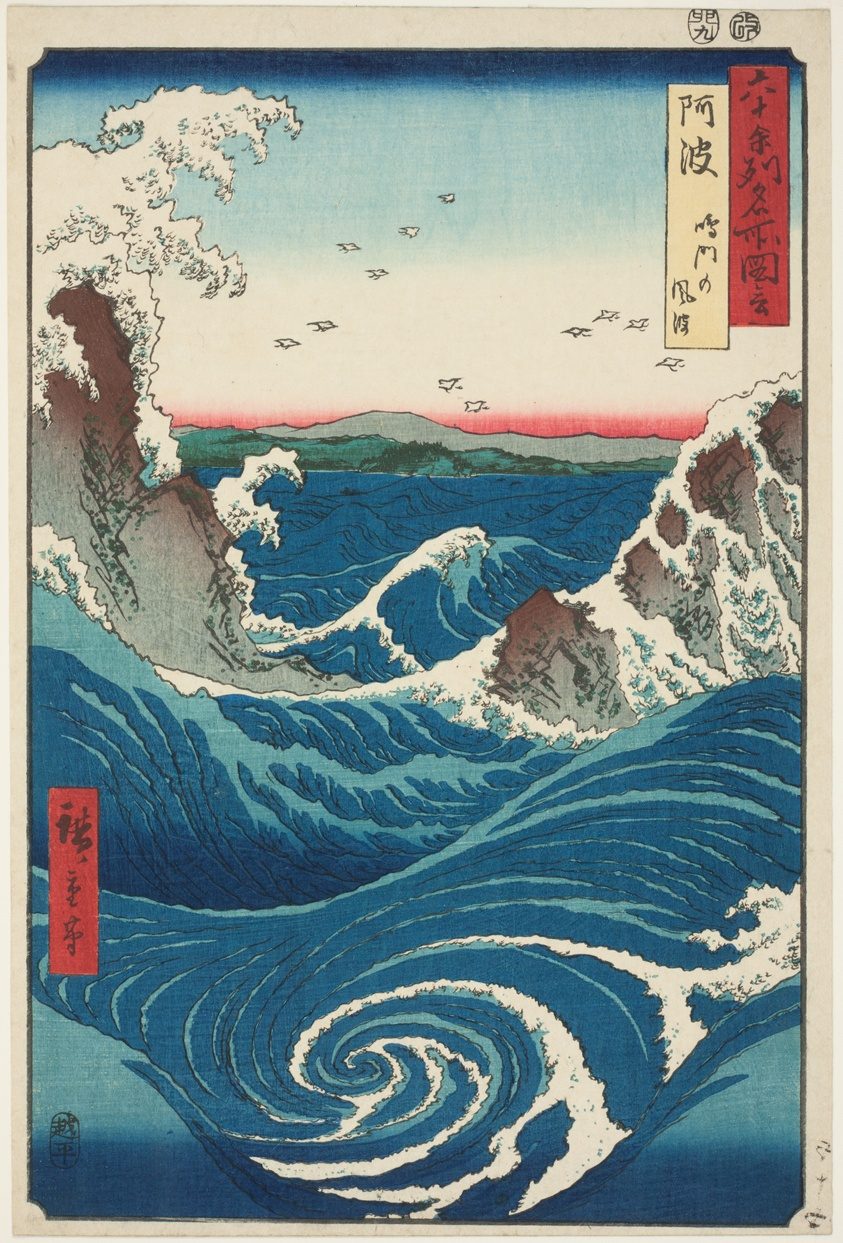
Utagawa Hiroshige, Awa Province: Naruto Whirlpools, 1855. A whirlpool and breaking waves between rocky outcrops, with birds over the strait. Utagawa Hiroshige, "Awa Province: Naruto Whirlpools", 1855. Art Institute of Chicago, CC0.

The pool, kept small

Six shelves around the price

One fifth of the vault sits in the SaucerSwap pool, but not the way most people use it. Not a range around the current price: that sells your HBAR on every rise and buys it back on every fall, exactly the wrong way round. We tested it on five coins. It lost on all five.

Instead: six shelves. Three buy shelves below the price, holding only dollars. Three sell shelves above it, holding only HBAR. Ten percent apart. When the price drops to a buy shelf, it buys HBAR there, and that HBAR moves to a sell shelf one step higher. When the price rises to a sell shelf, it sells, and the dollars move to a buy shelf one step lower. Every round trip locks in the step and earns pool fees both ways.

The shelves are the shock absorber, not the engine. They soften the swings and earn something from them. They are never rebuilt during a fast move, never in ebb, and the deepest buy shelf only fills after a 30 percent fall.

price now +10%+20%+30% −10%−20%−30% HBAR sell shelves USDC buy shelves bought here, sells one step up sold here, buys one step down
Each round trip locks in the step.
生き甲斐 · 流動性

When the pool is in balance,
it grows on its own.

Where this can go wrong

Your situation, your numbers

Ask Nao what this could mean for you

Numbers depend on your goal — how much you'd start with, over how many years, how conservative you want to be. Rather than showing you our example, we made Nao. Tell her your situation and she'll show you what the strategy did, year by year, and what a plan like yours could look like, with honest scenarios and the assumptions in plain sight.

What the strategy actually does

Three tides, one rule

The vault reads the tide and moves with it. No predictions, no news, no sentiment, no stops. It sits still when it should and moves when the water has actually turned.

Flood

Ride the rise

Price is well above the waterline and has held there three days. Everything in HBAR, no profit-taking, no stops.

HBAR 100%
Slack water

Hold the middle

Price is near the waterline. Half HBAR, half dollars, and nothing else.

HBAR 50% · USDC 50%
Ebb

Wait it out, buy the panic

Price is well below the waterline and has held there three days. Everything in dollars, with three buy orders far below.

USDC 100% + three buy orders
Utagawa Hiroshige, Kii Province: Wakanoura Bay, 1855. Cranes flying over a calm bay with wooded islands and a young pine on the shore. Utagawa Hiroshige, "Kii Province: Wakanoura Bay", 1855. Art Institute of Chicago, CC0.

What the numbers say

The backtest, and the months ahead

In a backtest from mid-2020 to September 2026, $2,000 in HBAR became about $5,000 by holding. The same $2,000 in this strategy became $30,000 to $38,000, depending on how much sat on the shelves. Nearly all of that difference comes from two years: 2022, when holding lost 87% and the vault about 40%, and 2025, when holding lost 60% and the vault about 8%. At its worst point the vault stood 60 to 70 percent below its peak; holding stood 93 percent below.

That is one coin, two cycles, on daily prices. The pattern held on dozens of settings and on four other coins. It is not a promise.

Backtest · $2,000 in, mid-2020 to September 2026
Holding HBAR≈ $5,000
The vault$30,000–38,000
Almost all of the gap was made in 2022 and 2025, the two big falls.
Live · $1,000 in on September 23, 2026
Holding HBAR…
The vault…
 

Both after all costs: pool fees on swaps, price impact and gas. In a rise, holding usually does a little better; in a real fall, the vault sits in dollars. Over weeks the two stay close. The difference shows over a whole cycle.

Backtest · mid-2020 to September 2026
Live · since September 23, 2026
YearHoldingVaultDifference
loading…

Backtest on Binance HBAR/USDT daily closes, $2,000 start, no deposits, including swap fees, slippage and gas. Vault variant: 80% following the tides, 20% on the shelves (10% apart, three per side). Difference in percentage points.

Live, since September 23, 2026

One line from the day the strategy went live until now, on the private test account. A new point on the first of every month, so you always see the whole record, not just the last month. Deposits don't count as gains.

Month endHBARHoldingVaultDifference
loading…

Change since September 23, 2026. Vault: the test account's value with deposits taken out (modified Dietz per month, chained), shelves included, after all costs. Holding: the HBAR price against the price at the start.

Updated on the first of every month. The good months and the others.

The vision

Where the vault actually works

Ikigai describes a good life as the meeting point of four questions. Most people get two or three. This vault works on one of them — the fourth — so the other three have more room.

The fourth quadrant — what pays

For most people this is where the compromises happen that undermine the other three. Someone picks work that pays and gives up on what they love. Or work they're good at, and gives up on meaning.

This vault doesn't fill the fourth quadrant. It strengthens it, slowly, over years — so you have more room to choose in the other three.

we work here · on the fourth
The arrangement

Simple, and in that order

You keep custody. You deposit from your own wallet and withdraw whenever you want. No entry fee, no exit fee, no lock-up, no yearly charge.

We take one thing: 15% of your gain, at the moment you take it out. Your gain is what you withdraw above what you put in, measured in US dollars. If there is no gain, there is no fee. If the vault fell and only climbed back to where you started, there is no fee. We earn when you leave with more than you came with. Not before, and not otherwise.

15%
Of your gain, when you take it
0
If there is none
Always
Withdraw when you want

Gains are measured in dollars, not in HBAR. In a flood the vault holds HBAR, in an ebb it holds dollars. You withdraw whatever the vault holds at that moment, and the fee comes out of the same.

An example, not a promise
You deposit $500 and add $100 a month for ten years: $12,500 in total.
You withdraw $37,000. Your gain is $24,500.
The fee is 15% of the gain: $3,675. You keep $33,325.
Had you withdrawn $12,000, there would be no gain, and no fee.
The foundations

Built for the long horizon

This vault sits on top of two systems we didn't build ourselves — but chose deliberately. If either of them ever went bad, so would we. Here's what they are and why we trust them enough to build something we intend to run for a decade.

Utagawa Hiroshige, Evening Snow at Kanbara, c.1833-34, from the series Fifty-three Stations of the Tokaido
Hiroshige · Evening Snow at Kanbara · c.1833
一 · Hedera — the ground beneath

A blockchain built by people planning to be here in a century

Hedera is the network our smart contract lives on. It's a public ledger like Ethereum, but built differently — and for different reasons.

"Our intent is to build a 100-year company. We're not in this for the short term. We're building the next generation of infrastructure that will be here for the next century."
— Mance Harmon, Hedera co-founder

That's not a marketing line. It shows up in every technical and governance decision they've made.

Decentralization by governance, not by anarchy. Hedera is governed by a council of up to 39 organizations — including Google, IBM, Boeing, Deutsche Telekom, and Tata — each with an equal vote, each on a limited term. That's a very different flavor of decentralization than most blockchains offer. Bitcoin trusts miners; Hedera trusts a rotating set of companies whose reputations depend on the network staying honest.

Ultra-low, predictable fees. A transaction on Hedera costs a fraction of a cent — $0.0001, denominated in dollars and stable. Which matters a lot when you're depositing €100 a month and don't want fees eating your margin. On Ethereum during busy hours, one swap can cost more than €30.

$0.0001
per transaction
~3 sec
to finality
10,000+
tx/sec capacity

Nobody can see your trade coming. On most blockchains, submitted trades sit in a public list for a moment before being processed — long enough for automated bots to spot yours, jump in front of it, and skim a small profit from the price impact. This is a real cost: users on Ethereum lose hundreds of millions of euros a year to this practice. Hedera processes trades in the order they arrive, with no public waiting-list — so no one gets a preview, and no one can cut the line.

The team. Hedera was founded by Dr. Leemon Baird — the mathematician who invented the underlying hashgraph consensus algorithm — and Mance Harmon. Both are Air Force veterans, both PhDs, and Baird's algorithm has been peer-reviewed for over a decade. In September 2024, they transferred all core code to the Linux Foundation as an open-source project (Hiero), a rare move for a well-funded blockchain company.

二 · SaucerSwap — the marketplace

A decentralized exchange built by people who use it themselves

SaucerSwap is where the actual trading happens. If Hedera is the ground, SaucerSwap is the marketplace we set up shop in.

What a DEX is. A decentralized exchange is a marketplace without a middleman. Traditional exchanges like Coinbase or Binance hold your money, match buyers to sellers, and take a cut. A DEX replaces all of that with smart contracts: the swap logic, the price discovery, and the fee distribution all happen on-chain, transparent to everyone. Nobody holds your money except you. When you trade, you trade with the pool directly — a system called an automated market maker (AMM). The pool sets prices based on the ratio of tokens in it, and rebalances itself with every swap.

Why SaucerSwap in particular. They were the first DEX on Hedera, launched in 2022, and remain by far the largest — over $6 billion in all-time volume, more than 19 million trades. But size isn't why we chose them.

Non-upgradable smart contracts. Most DeFi projects deploy contracts that the developers can upgrade later. This is convenient but dangerous — a bad upgrade, a compromised key, and everyone's funds are at risk. SaucerSwap's contracts are non-upgradable by design. What you see today is what stays. If they want to change something, they have to deploy new contracts and let people migrate. That's inconvenient for them and safer for everyone else.

V2 concentrated liquidity. SaucerSwap V2 is a Uniswap V3-style engine that lets liquidity providers place their capital at a specific price range instead of spreading it across every possible price. Most people use it for a range around the current price. We don't: we tested that on five coins and it lost on all five. The vault uses SaucerSwap for its swaps when the tide turns, and for the shelves: small one-sided positions that buy below the price and sell above it.

Backed by the ecosystem. SaucerSwap is co-founder of the Hashgraph DeFi Alliance and accelerated by both The HBAR Foundation and The Hashgraph Association. They're not a side project — they're the anchor of DeFi on Hedera, and the ecosystem knows it.

三 · How Ikigai fits

Using the best of both, doing the one thing they don't do themselves

Hedera gives us the ground: stable fees you can plan around for a decade, no frontrunning eating our trades, and a governance model built to still exist in 2100. Without that, monthly deposits of €100 wouldn't make sense — the transaction costs alone would eat them.

SaucerSwap gives us the marketplace: a battle-tested, non-upgradable DEX where the vault swaps when the tide turns and keeps its shelves. We didn't build the exchange and we don't want to. That's their craft, done well.

What we add is the timing and the discipline. Holding through a crash costs most of it; trading every ripple costs the rest. Someone has to decide when to hold HBAR, when to hold dollars, and when to hold half of each, and then sit still until the tide has truly turned. That's what our strategy does. That's the whole thing.

Three parts, each doing what it does best: Hedera as the ground, SaucerSwap as the marketplace, Ikigai as the discipline.